
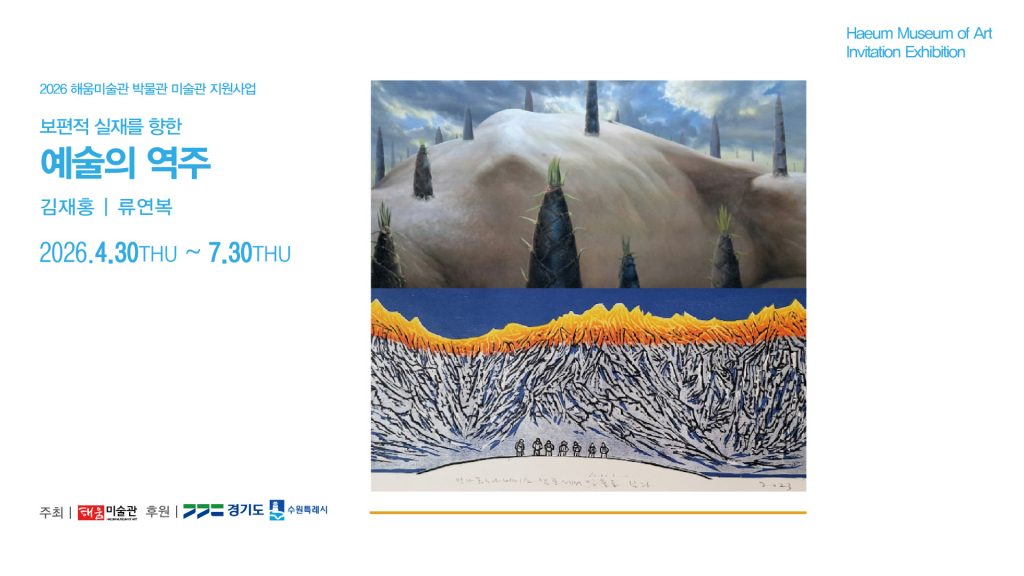
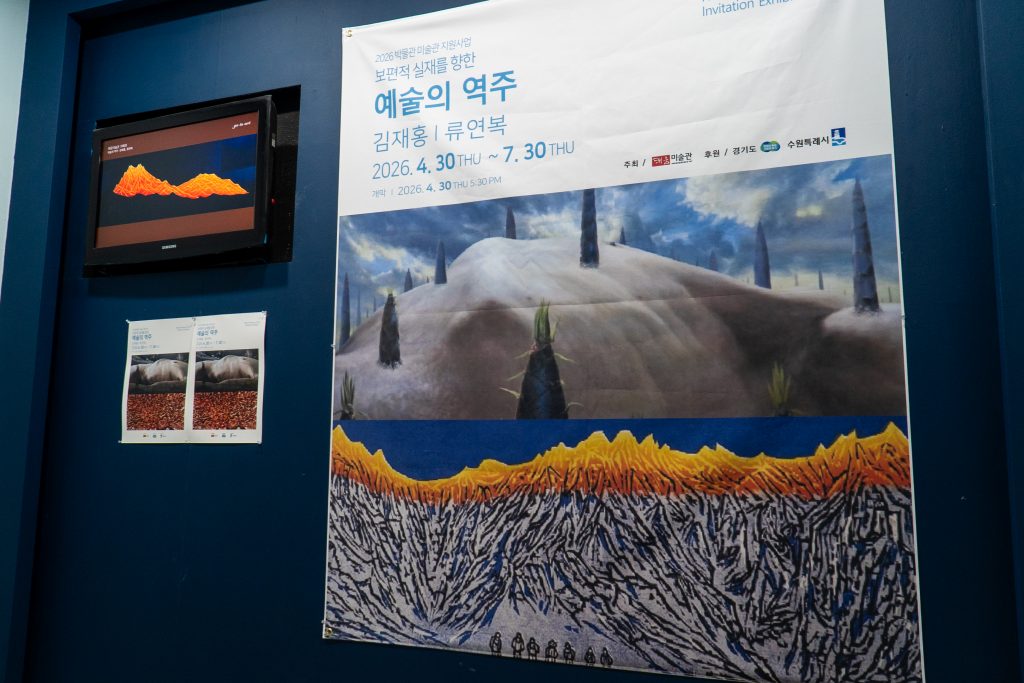
보편적 실재를 향한 예술의 역주(力走) “김재홍∙류연복 展”
참여작가: 김재홍,류연복
2026년 4월 30일 – 7월 30일
Apr. 30 – Jul. 30, 2026
이번 전시는 시대적 유행에 휩쓸리지 않고 인간의 본질과 대지의 생명력을 끈질기게 추적해 온 김재홍,류연복 두 거장의 예술적 궤적을 재조명한다.
단순히 과거로 돌아가는 것이 아니라, 근원(Real)을 향해 거슬러 올라감으로써 현재의 결핍을 채우는 ‘미학적 역주를’제안함으로써 상상계적 환상에서 벗어나, 역사와 생명의 뿌리에 박혀 있는 불편하지만 진실한 실재와 조우하게 한다.
특히 2026년 미술계의 ‘인간 중심주의 탈피’와 ‘에코-센트릭’트랜드와 접점을 이루는 두 작가의 세계관은 자연을 관찰의 대상이 아닌 ‘나와 같은 생명을 가진 실재’로 대우함으로써 현대 미술이 추구하는 지속가능한 보편적 진실에 해답을 제시하고자 한다.
어제와 오늘, 오늘과 내일이 급변하는 사회와 환경 속에서 ‘보편’과 ‘평범’을 추구하는 것은 삶의 주체인 한 인간이 정적이고 수동적이라는 인과관계로만 치부할 수 없다. 어쩌면 그 누구보다 동적이고 능동적인 애씀으로 평범이라는 수면 아래 힘차게 물질하는 백조와 같은 삶을 살아내는지도 모른다. 인간 및 자연을 작품의 주요 서사로 풀어가는 김재홍 작가와 류연복 작가의 진지함이라는 공통점은 서로 다른 표현 방식인 회화와 판화라는 장르를 통해 감상자에게 입체적인 감상 기회를 제공한다. 동일한 사물이라도 사물 뒤에 자리한 배경과 사회적∙역사적 맥락에 따라 그 의미가 재생산되듯 두 작가의 작품 속에서 표현된 일상의 모습이 감상자 개개인의 시간과 맞물려 다양한 방식과 의미로 재생산될 수 있도록 생활 속 미술 감상 기회를 제공하려고 한다.
전시소개(요약)
김재홍은 풍경이라는 상징적 질서 이면에 숨겨진 존재의 진실을 목도하게 한다. 그의 캔버스에서 산하(山河)는 단순히 감상의 대상이 아니다. 그것은 고통받는 육체이자, 우리를 품어온 거대한 생명의 자궁이다. 풍경 속에 은닉된 형상을 발견하는 순간, 관람객은 세련된 가상(Simulacre)의 세계를 넘어 불편하지만 고귀한 ‘실재(The Real)’와 대면하게 된다.
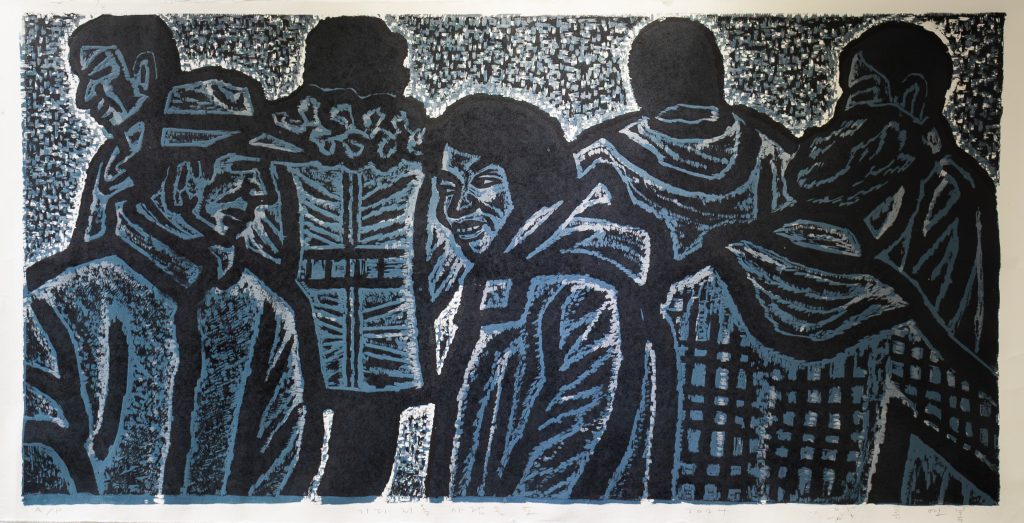
류연복은 국토라는 역사의 몸에 칼을 대어 그 숨결을 새긴다. 그의 목판화는 단순한 기록을 넘어선 수행적 각인이다. 거친 나무판 위에 새겨진 단단한 선들은 과거의 상처를 현재의 생명력으로 치환하는 강력한 언어이기도 하다. 그는 땅의 무의식을 긁어내어, 우리가 딛고 선 이 땅이 얼마나 치열한 시간의 역주를 견뎌왔는지를 증언한다.
이번 전시는 두 작가가 평생을 바쳐 추구해 온 ‘예술적 정직함’에 관한 기록입니다. 이들은 민중미술이라는 시대적 파고를 넘어, 인간과 자연, 역사라는 보편적 층위로 자신들의 미학을 확장해 왔습니다. 유화의 치밀한 붓질과 목판의 강인한 칼질이 교차하는 이 공간은, 파편화된 현대인의 삶을 다시금 거대 생명의 흐름 속으로 연결하는 회복의 장이 될 것입니다.
우리는 이 역주를 통해 비로소 정지할 수 있으며, 그 정지된 찰나에 비로소 보이는 것들이 있습니다. 그것이 바로 우리가 회복해야 할 보편적 실재입니다. 2026년의 길목에서, 두 작가가 일구어 놓은 이 깊고 단단한 사유의 숲으로 여러분을 초대합니다.
[전시 키워드]
▶ 포스트 디지털 시대의 ‘물성(Materiality)’ 회귀
: AI 생성예술의 범람에 반작용으로, 작가의 신체적 노동이 집약된 ‘진본성’ 가치를 재조명
류연복 작가의 투박하고 날카로운 목판화 칼자국과 김재홍 작가의 세밀한 붓질은 디지털이 흉내 낼 수 없는 강력한 회화적 에너지를 전달하며, 관객에게 시각을 넘어선 촉각적 경험을 제공.
▶ ‘에코-아카이브(Eco-Archive)’와 역사적 생태학
: 단순한 자연 보호를 넘어, 자연을 ‘역사적 목격자’로 기록하는 전시 기획
자연과 인체의 이중구조로 표현된 인체-풍경은 자연을 객체가 아닌‘살아있는 주체’로 격상시키며, 류연복의 ‘국토 기행’은 땅에 새겨진 ‘민중의 기억’을 복원 한다는 점에서 기후 위기 시대에 인류가 가져야할 ‘생태적 책임감’이란 물음을 던짐과 동시에 실천적 행동을 촉구한다.
전시 평론
<온(溫).한(寒)의 표면-붓과 칼의 담(談)>
평론: 이선영 평론가
번역: 이영교 박사 (한국박물관협회 뮤지엄커넥션 전문번역가)
많은 것들이 코드로 변환돼 순환되는 정보화 시대에 자연과 인간, 그리고 예술의 뿌리는 어디에 있을까. 예술사는 정보화가 본격적으로 이루어지기 전부터 ‘현대’와 ‘실험’을 앞세워 조형 언어의 코드화를 지향하기도 했다. 가령 동구와 서구의 구성주의는 추상미술을 넘어서 건축과 디자인 등으로 확장되고 예술을 지양하기에 이르렀다. 전후에는 각종 ‘POST-’ 국면들 또한 인간, 역사, 근대처럼 처리하기 힘든 묵직한 것들을 가볍게 초월했다. 그러나 분업화가 가속도를 붙이면 붙일수록, 그래서 삶이 더욱 파편화될수록, 예술은 실재(the Real)를 향한 근원적 향수에 잠긴다. 자끄 라캉은 그자체로는 재현될 수 없지만 무의식처럼 분명히 존재하는 실재를 바다나 대지와 비유한 바 있다. 실재는 모든 지상적 존재의 출발이자 귀결이지만, 그자체로는 자명하게 드러나지 않으며, 끝없는 과정을 통해 접근될 따름이다. 예술은 과학이나 종교 등과 더불어 그러한 과정을 수행하는 몇 안되는 중요한 분야로 생각된다.
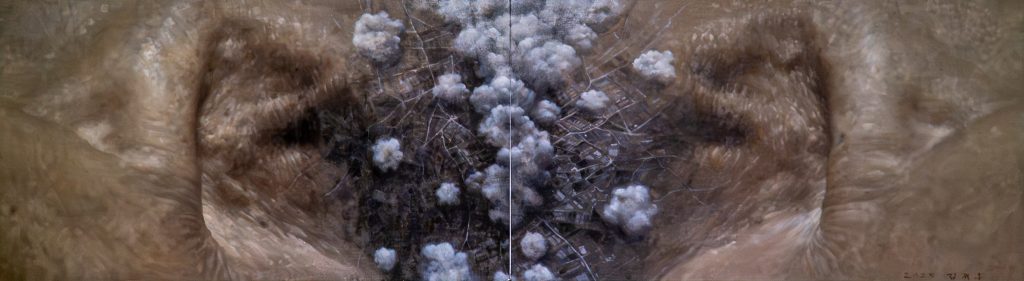
김재홍, 융단폭격_Oil on canvas_50x180.5cm_2025
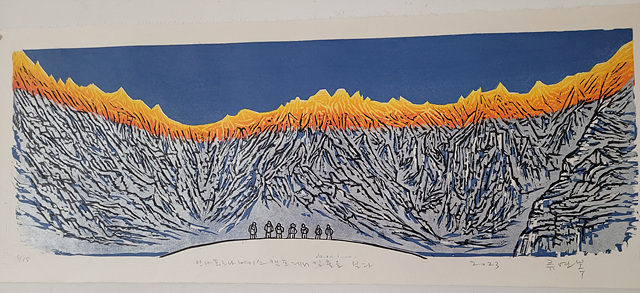
류연복, 안나푸르나베이스캠프에서일출을보다
김재홍의 회화와 류연복의 판화는 인간 및 자연을 작품 서사의 중심에 두는 진지함이 공통적이다. 청년 시절 진보적 문화예술의 맥락에서 읽혀왔던 그들의 작품 경향이 20세기만큼이나 21세기에서도 유효한 이유는 작품의 지평이 보편적인 삶에 닿아있기 때문이다. 다른 정보처리 방식으로도 가능한 시시콜콜한 항목들의 재현을 넘어서, 그렇다고 관념적인 초월도 지양해야 하는 까다로운 요건을 충족시키면서 삶에 대해 말한다. 김재홍은 몸과 대지를 중첩시킨 풍경을 통해 이 땅의 몸뚱아리에 닥쳤던 비극적 역사를, 류연복은 자연의 풍요로움과 거대함을 부각시키면서 희망적인 메시지를 제시한다. 이러한 두 경향이 어두운 현실 비판과 밝은 전망이라는 이전 시대의 추상적 코드로 환원될 수 없다. 그들 작품의 토대인 자연은 비극도 희극도 아닌 그저 있음일 따름이다. 하지만 있음의 확인만도 큰 위로가 되는 탈중심의 시대다. 대지에 기반한 김재홍과 류연복은 긴 시간의 주기를 가지는 실재를 향한 추구의 과정을 보여준다.
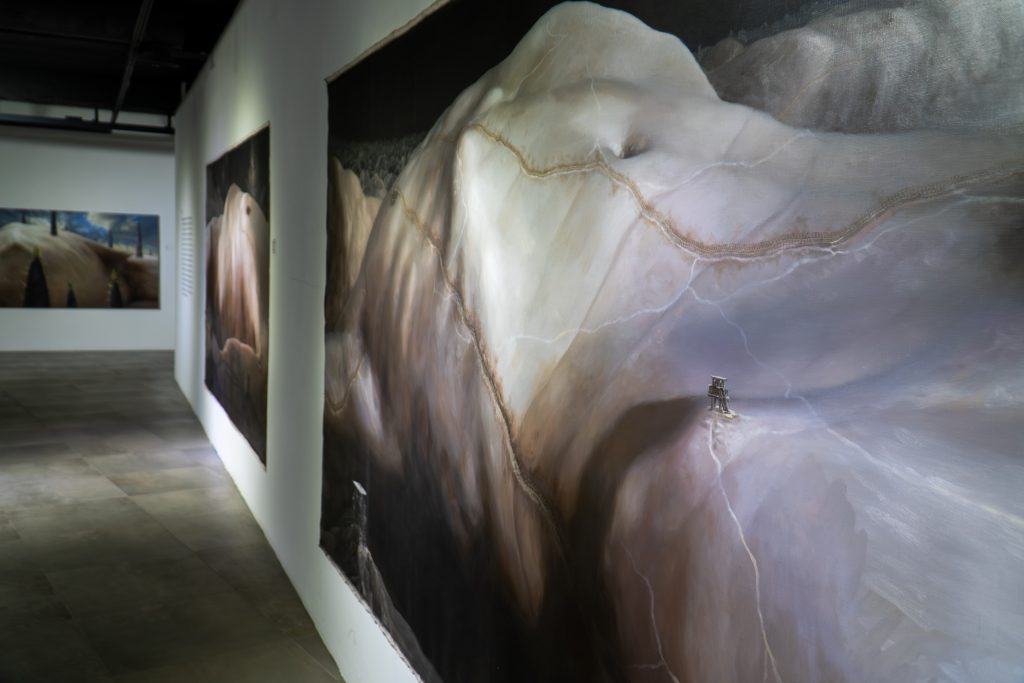
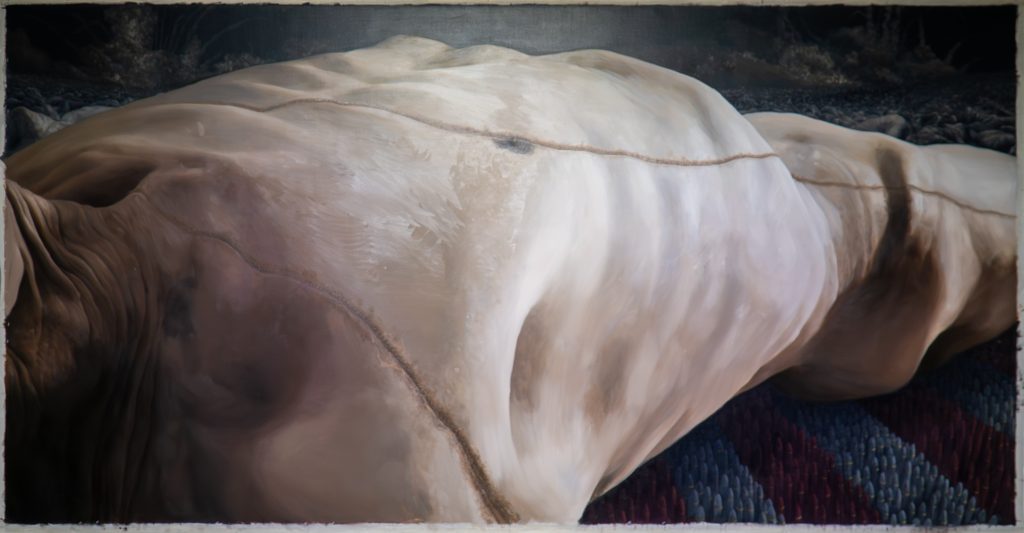
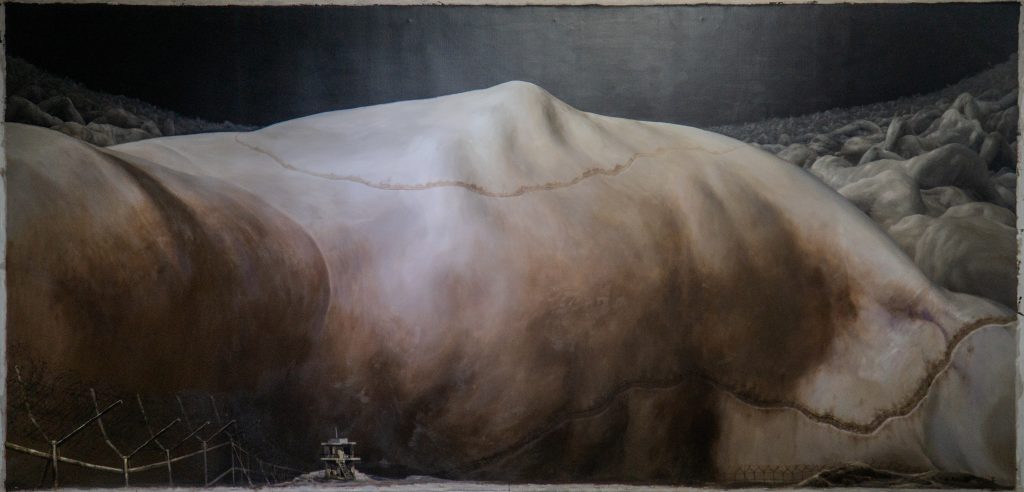
스펙터클하게 펼쳐진 김재홍의 최근 작품 [융단폭격]은 대지이자 몸이 풍경(bodyscape)을 이룬다. 바디스케이프는 자명하게 가정된 자연이 아닌, 각종 권력의 관통하는 유동적인 장(場)이라는 의미로 사용된다. 색감은 몸의 일부로 보이지만 거인의 전모를 다 담아내지는 않는 작품들은 몸의 어느 부분인지 알 수 없다. 완전한 대칭은 아니지만 좌우로 비슷한 모습이 대칭을 이루는 몸의 구조를 떠올린다. 폭탄 눈 시점으로 펼쳐진 온몸은 무차별 공격 대상이 된다. 다른 작품들에서 몸은 여러 각도로 배치되어 낯선 풍경으로 보여진다. 피부는 몸의 안과 밖의 경계가 되는데, 융단폭격은 그 경계를 허물어 죽음에 이르는 깊은 상처를 만든다. 최근까지도 지속되고 있는 세계 여기저기에서의 전쟁 참상은 이전부터 그가 그려왔던 몸풍경을 현재화한다. [장막] 시리즈에 몸이자 대지로 등장하는 덩어리에서 창백한 몸에 상처처럼 찍힌 궤적은 허리 잘린 분단국가인 한국에서 그 의미를 쉽게 유추할 수 있다.
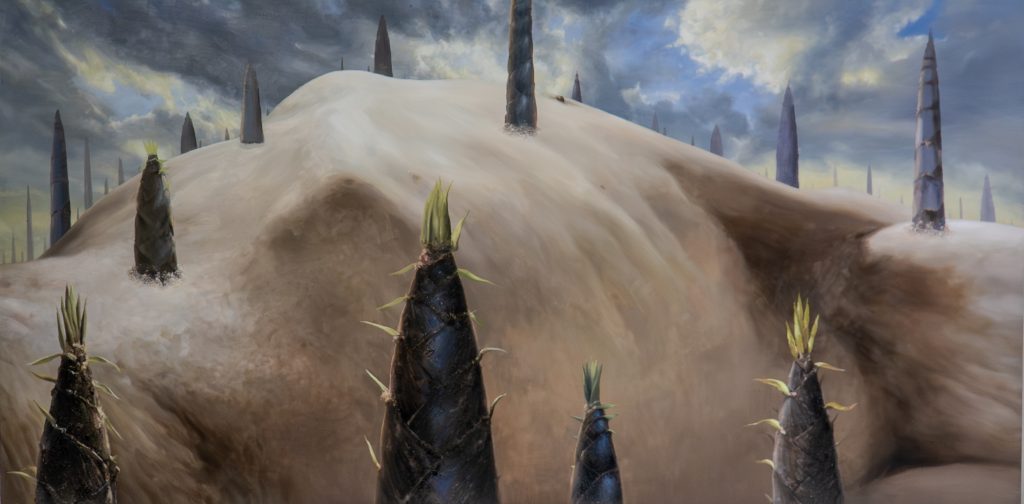 김재홍, 죽순_Oil on canvas_122x244cm_2025
김재홍, 장막-20260101_Oil on canvas_160x316cm_2026 (2)
김재홍, 장막-20250728_Oil on canvas_160x338cm_2025
몸이자 대지 안팎의 감시초소들은 분단의 현실 뿐 아니라 몸 자체가 감시의 그물망 속에 있음을 말한다. 모든 경계의 설정 및 유지, 확산에는 권력이 있다. 권력은 문지기다. 힘에 의해 유린된 몸은 삶과 죽음이 구별되지 않은 극도의 수동성을 보인다. 우리의 근대사 또한 민간인 학살을 포함한 많은 희생으로 점철돼 있다. 철조망과 초소, 그리고 분단의 상흔을 나타내는 기표들은 대량 살상이 운명적 사건이 아닌 사회 역사적 사건임을 말한다. [장막]이라는 제목은 감춰지고 억압된 것의 베일을 벗긴다는 의미이리라. 하지만 그의 작품에서 몸 자체가 장막이기도 하다. 장막 뒤에 또 다른 장막이 있다. 어두운 배경 속 밝게 처리된 몸은 관객 앞으로 불쑥 튀어나오는 듯하다. 과장된 원근법은 말 없는 풍경에 외침을 부여한다. 작품 [죽순]에서 대지에 드러누운 몸은 이런저런 굴곡을 가진 산등성이처럼 보인다. 죽창을 떠올리는 뾰족한 말단은 비록 그것이 부드러운 죽순이라 할지라도 몸을 관통하는 고통의 강도를 표현한다. 하지만 지상의 유기적 질서는 죽음을 토대로 또 다른 삶을 가능하게 한다.
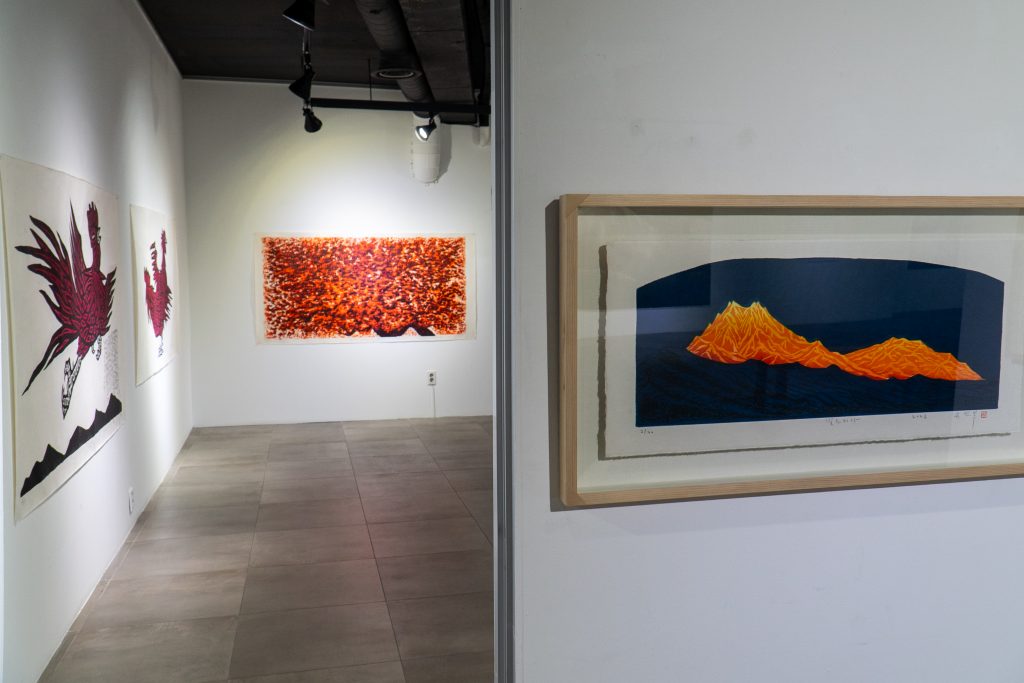
화면 전체를 꽃으로 뒤덮은 류연복의 꽃나무는 동물에 비해 정적이라고 믿어지는 식물을 폭발적 에너지로 변환시킨다. 그것들은 자기 자리를 지킨 채 격렬하게 운동하고 있다. 그의 작품은 단지 아름다운 자연의 한 장면을 넘어서, 지배권력의 불의에 항거하여 광장에 모인 촛불이나 응원 봉의 불빛이 연상되는 색감과 형태로 이어진다. 가지가 많아도 균형을 이루어 안정감 있는 나무는 아름답다. 거기에서 가득 피어난 꽃들은 화면 바깥까지 이어질 것이다. 작가는 나무를 화면 중앙에 배치하여 세계수(世界樹) 같은 위용을 부여한다. 세계수는 세계의 중심에서 자라며, 땅과 하늘을 잇는 영험한 존재이다. 이 상징적 중심은 지상의 기원을 염원하는 의미 있는 자리가 되며, 각기 다른 차원을 연결함으로서 존재의 변모를 꾀한다. 매일 새로운 ‘OO현실’들이 말해지는 현재, 자연의 실재감은 삶 뿐 아니라 그림의 모델이 되기도 한다. 풀 또한 나무처럼 여러 계를 관통하는 중심으로 나타난다.
류연복, 꽃한송이_채색판화,2025
류연복,ROADKILL-삵, 단색목판, 2025.
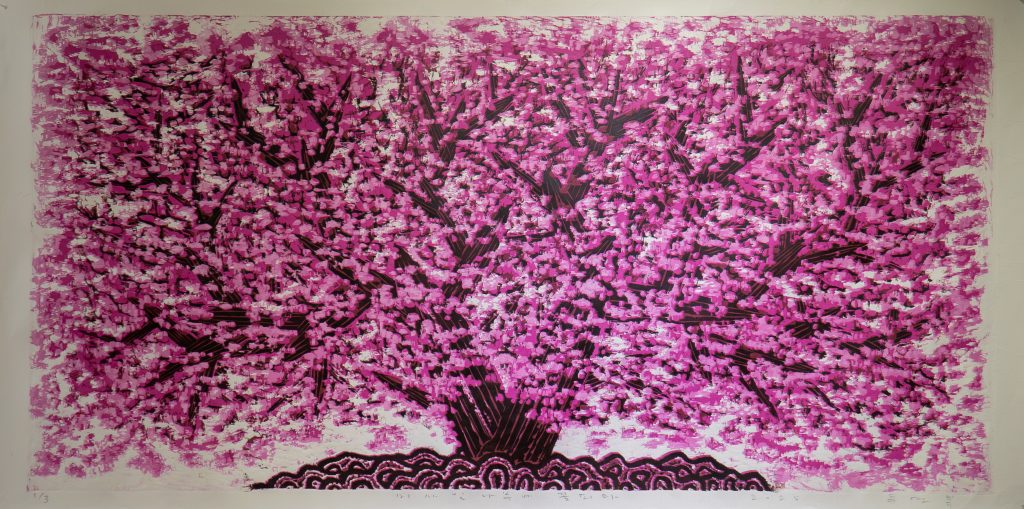
류연복, 미사일나무에 꽃피다, 소멸다색목판, 2025.
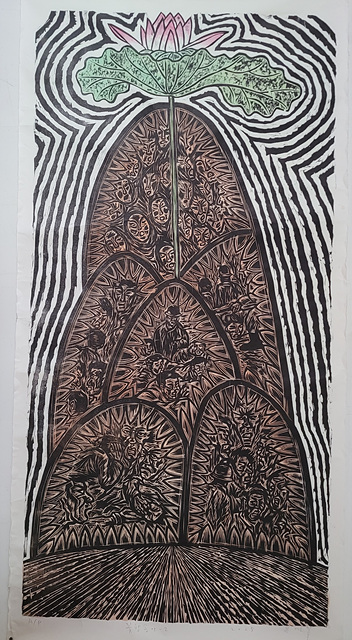
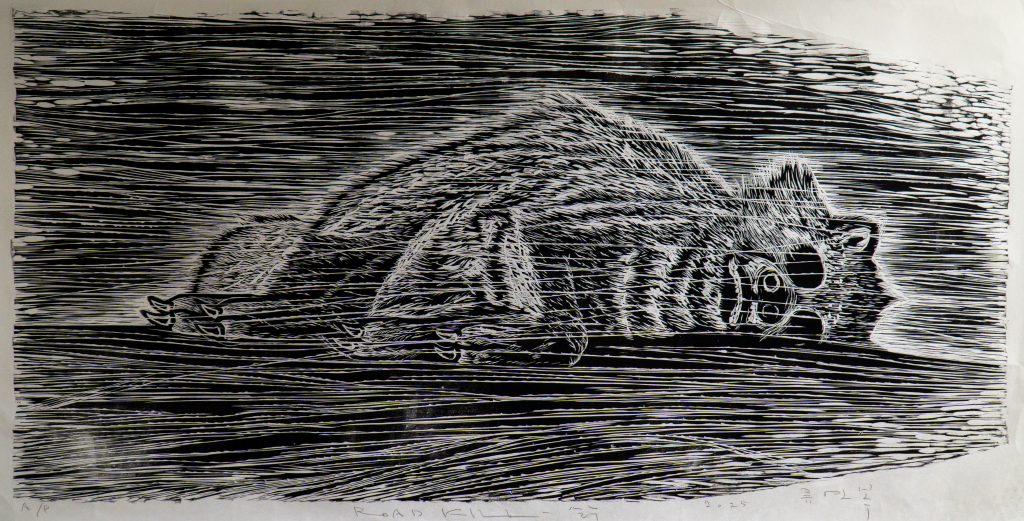
류연복의 작품 속 진흙 속에서 피어나는 연꽃은 승화의 상징이다. 작가는 진흙에 해당되는 부분에 관객의 시선을 모은다. 아름닾게 핀 연꽃 지하에 묻힌 어두운 광경을 투시한다. 우리 근대사에 점철된 여러 폭력적인 사건과 갈등을 딛고 피어난 꽃은 여전한 희망 사항이다. 누워있는 동물은 죽은 것일까 자는 것일까. 인간의 영역이 극대화되면서 자연이 처해진 상황을 염두에 둘 때 슬픈 일들은 더 많지만, 자연의 순리는 모든 것들을 다시 순환시킨다. 류연복의 작품에도 자주 등장하는 매해 다시 피는 고목은 재생의 상징이다. ‘안나푸르나 베이스 캠프에서 일출을 보다’라는 기록이 남겨진 작품은 웅장한 산과 작은 인간들을 대조한다. 마주한 사람들 앞에 장대하게 펼쳐진 산맥은 마치 거대한 해일이나 산불처럼 압도적으로 다가오는 힘이 있다. 자연의 숭고함과 마주한 인간은 우주 안에서 자신의 위치를 다시금 생각하게 된다. 그의 판화는 자연에 내재된 풍부한 질감을 극대화한다. 에너지의 흐름이 물질화된 풍경은 자연처럼 여러 겹으로 이루어진 판화라는 매체를 통해 재탄생한다.
Review of the exhibition
<The Counterpoint of Art Toward Universal Reality>
Sun-Young Lee (Art critic)
Translated by Dr. Younggyo Lee (2025,2026 Museum Connection of The Korean Museum Association Professional Translator)
In an age defined by the endless circulation of coded information, where might we locate the roots of nature, humanity, and art? Long before the full emergence of the information era, the history of modern art had already pursued the codification of visual language under the sign of experimentation and modernity. Constructivism, in both Eastern and Western contexts, extended beyond abstraction into architecture and design, ultimately aspiring toward the dissolution of art itself as an autonomous domain.
In the postwar period, the various discourses of the “post-” likewise attempted to move beyond those dense and unyielding concepts—humanity, history, modernity—that resist simple transcendence. Yet the more radically specialization advances, and the more fragmented contemporary life becomes, the more profoundly art is drawn toward a primordial longing for the Real.
Jacques Lacan(1901–1981) once described the Real as something irreducible to representation, yet undeniably present like the unconscious itself, comparing it to the sea or the earth. The Real is at once the origin and the destination of all worldly existence, though it never discloses itself transparently or in fixed form. It remains something that may only be approached through an interminable process of encounter. Art, alongside science and religion, remains one of the few enduring fields through which such an approach to the Real continues to be pursued.
A shared seriousness underlies Kim Jaehong’s paintings and Ryu Yeonbok’s prints: both place humanity and nature at the center of their artistic narratives. The reason their practices—once read within the framework of progressive cultural and artistic discourse during their youth—remain as resonant in the twenty-first century as they were in the twentieth lies in the fact that their artistic horizons remain deeply connected to universal human experience.
Their works speak of life while fulfilling a demanding condition: moving beyond the reproduction of trivial details that could just as easily be processed through other informational systems, yet equally resisting retreat into purely abstract transcendence. Kim Jaehong evokes the tragic histories that have befallen the body of this land through landscapes in which body and terrain are superimposed, while Ryu Yeonbok foregrounds the abundance and immensity of nature to suggest messages of renewal and hope.
Their works speak of life while fulfilling a demanding condition: moving beyond the reproduction of trivial details that could just as easily be processed through other informational systems, yet equally resisting retreat into purely abstract transcendence. Kim Jaehong evokes the tragic histories that have befallen the body of this land through landscapes in which body and terrain are superimposed, while Ryu Yeonbok foregrounds the abundance and immensity of nature to suggest messages of renewal and hope.
Yet these two tendencies cannot simply be reduced to the abstract binaries of an earlier era—dark social critique versus optimistic futurity. Nature, the shared foundation of their practices, is neither tragic nor comic; it simply exists. And in this age of decentering, even the affirmation of existence itself can offer profound consolation. Grounded in the earth, both Kim Jaehong and Ryu Yeonbok reveal an artistic pursuit directed toward the Real—one that unfolds according to temporal cycles far longer than those of immediate human history.
Kim Jaehong’s recent work <Carpet Bombing> unfolds as a spectacular vision in which land and body converge into a single landscape—a bodyscape. Here, the term does not refer to nature as a self-evident or neutral given, but rather to a fluid field through which multiple forms of power penetrate and operate.
Rendered in visceral tones suggestive of flesh, these works imply fragments of a gigantic body without ever revealing its totality, leaving the viewer uncertain as to which part of the anatomy is being depicted. Though not perfectly symmetrical, their approximate bilateral structures evoke the inherent symmetry of the human body. Seen from the imagined perspective of a descending bomb, the body in its entirety becomes the indiscriminate target of attack.
In other works, the body is positioned from unfamiliar angles, transforming corporeal form into an alien terrain. Skin ordinarily functions as the boundary between the interior and exterior of the body; in Carpet Bombing, however, that boundary is violently breached, producing wounds of devastating depth that lead toward death. The ongoing devastation of wars still unfolding across the world lends acute contemporaneity to Kim’s long-standing bodyscapes, making them feel less metaphorical than urgently present.
In the <Drapery series>, the mass that appears simultaneously as body and terrain bears pale surfaces marked by scar-like traces. For viewers in Korea—a nation itself severed at the waist by division—the symbolic resonance of these wounds is immediate and unmistakable.
The guard posts positioned within and around the body-as-landscape evoke not only the geopolitical reality of division, but also the condition of the body itself as enmeshed within networks of surveillance. The establishment, maintenance, and expansion of all boundaries are inseparable from power. Power functions as a gatekeeper.
The violated body, subjected to force, is rendered in a state of extreme passivity where the distinction between life and death becomes uncertain. Korea’s modern history, too, has been marked by profound sacrifice, including the mass killings of civilians. Barbed wire, watchtowers, and other visual signifiers of division and trauma in Ryu Yeonbok’s work suggest that mass violence is not an inevitable or fated occurrence, but a sociohistorical construct.
The title <Drapery> may be understood as an attempt to unveil that which has been concealed or suppressed. Yet within the work, the body itself becomes a curtain. Behind one veil lies another. Illuminated against a darkened background, the body seems to lunge forward into the viewer’s space. The exaggerated perspective lends a silent landscape the force of an unspoken cry.
In <Bamboo Shoot>, the body stretched across the earth resembles a mountain ridge, marked by undulating contours. The pointed extremities evoke sharpened stakes; even if they are, in fact, tender bamboo shoots, they convey the piercing intensity of pain that penetrates the body. Yet the organic order of the terrestrial world suggests that death is never an absolute end, but the condition through which another form of life becomes possible.
Ryu Yeonbok’s flowering trees, which engulf the entire pictorial field in blossoms, transform plants—often perceived as still and passive in contrast to animals—into embodiments of explosive energy. Though firmly rooted in place, they appear to move with remarkable intensity. His works extend beyond the depiction of beautiful natural scenery; their chromatic force and formal rhythms evoke the flickering candlelight and luminous cheering sticks raised in public squares in resistance to injustice and abuses of power.
A tree achieves beauty through balance, even when its branches proliferate in abundance. The blossoms that erupt across its form seem destined to continue beyond the edges of the canvas, suggesting growth unconstrained by the picture plane. By placing the tree at the center of the composition, the artist endows it with the commanding presence of a World Tree (Axis Mundi). In mythic and spiritual traditions, the World Tree stands at the center of the universe, a sacred entity connecting earth and sky. As a symbolic axis, it becomes a site of origin and aspiration—a meaningful locus through which different realms intersect and transformation becomes possible. At a time when ever-new versions of so-called “realities” are constructed and proclaimed each day, the palpable presence of nature offers a form of authenticity that serves not only as a foundation for life, but also as a model for painting itself. Even grass, like the tree, emerges as a central form that traverses multiple realms of existence.
In Ryu Yeonbok’s works, the lotus blooming from the mud serves as a symbol of transcendence and sublimation. Rather than directing the viewer’s attention solely toward the flower in bloom, the artist draws the gaze downward—toward the murky depths from which it emerges. Beneath the beauty of the lotus lies a shadowed terrain, evoking the obscured histories of violence and conflict that have marked Korea’s modern past. The flower that rises from such ground remains, perhaps, an enduring expression of hope rather than a fulfilled reality.
The animal lying still within the composition provokes ambiguity: is it asleep, or has it died? When considered alongside the increasingly precarious condition of nature under the expansion of human dominion, the work suggests a landscape marked by sorrow and loss. Yet nature’s inherent order is cyclical, endlessly transforming and renewing all things. The weathered old tree, a recurring motif in Ryu’s oeuvre that blossoms anew each year, stands as an emblem of regeneration.
In the work inscribed <Watching the Sunrise at Annapurna Base Camp>, the artist juxtaposes monumental mountains with diminutive human figures. The vast mountain range unfolding before them possesses an overwhelming force—resembling a colossal tidal wave or an advancing wildfire. In the presence of such sublime natural grandeur, humanity is compelled to reconsider its own place within the cosmos.
Ryu’s printmaking practice powerfully amplifies the tactile richness embedded in the natural world. Landscapes in which flows of energy appear materialized are reborn through the medium of print—a layered process that mirrors the stratified complexity of nature itself.